The Edge in 30 Seconds
The Shift
A new AGC of America and NCCER workforce survey finds that 87% of construction firms have openings for hourly craft workers, while 88% of firms with craft openings say those positions are as difficult or more difficult to fill than they were a year ago.
The Risk / Opportunity
When skilled labor becomes the constraint, generating more demand without improving capacity can create longer response times, delayed estimates, scheduling bottlenecks and a worse customer experience.
The Move
Treat labor efficiency as part of your growth strategy. Automate repetitive administrative work, tighten your lead-to-job process, document repeatable workflows and reserve skilled employees for work that actually requires their expertise.
Contents
The New Numbers Behind the Skilled-Labor Shortage
The construction market may be cooling in some areas, but qualified workers haven't suddenly become easy to find.
The Associated General Contractors of America and NCCER released their 2026 Workforce Survey on September 3, based on responses collected during July and August from 1,830 individuals representing construction firms across a range of types and sizes. The results reveal an important disconnect.
Construction spending declined 0.5% from June to July and 3.8% compared with a year earlier, according to a separate September 1 AGC analysis of federal construction-spending data. Growth has become increasingly concentrated in areas including data centers, power projects and highway construction.
Yet contractors continue struggling to staff the work they do have.
That's not simply a recruiting problem. It's a capacity problem.
The Data Behind the Shift
87%
of respondents report openings for hourly craft positions. Among firms with craft openings, 88% say those positions are as hard or harder to fill than a year ago, and 50% say they are harder to fill. Across all survey respondents, 50% say available candidates are not qualified because they lack needed skills, certificates or licenses.
Why This Is More Than a Hiring Problem
Consider a growing electrical contractor with a strong reputation and a full schedule. The phone rings. Estimates need to go out. Customers need updates. Materials need to be ordered. Reviews need to be requested. Old estimates need follow-up. Invoices need attention. New leads need to be entered into the CRM. And the owner is standing on a jobsite trying to finish today's actual electrical work.
Hiring another licensed electrician might increase field capacity — if you can find one. But adding another electrician to compensate for inefficient administrative processes is an extraordinarily expensive way to solve an operations problem. That distinction matters.
The new survey shows the consequences are already reaching project delivery: 42% of respondents said shortages of their own workers or subcontractors' workers had delayed projects, making workforce shortages the most commonly reported cause of project delays in the survey.
What This Means for Electrical & Home-Service Contractors
For years, the default growth equation for many contractors looked something like: more marketing → more leads → more jobs → hire more people → grow. But when qualified labor is scarce, that equation becomes harder to sustain.
More leads flowing into an already overloaded operation can expose existing weaknesses: calls go unanswered, estimates sit without follow-up, customers wait too long for updates, scheduling becomes reactive, owners spend evenings doing administrative work, technicians handle tasks that don't require technician-level expertise, and good opportunities quietly disappear from the pipeline.
The growth question therefore changes. Instead of only asking “How do we get more leads?” contractors also need to ask: “How much more revenue could our existing team handle if the business operated better?”
The Data-Center Effect
One of the most interesting findings in the new survey involves data centers. 28% of respondents reported performing construction work on a data-center project during the previous 12 months. Among those firms, 58% said data-center projects increased competition for skilled workers, 49% reported increased wage pressure, and 37% identified worker or subcontractor availability as their biggest challenge in pursuing or delivering those projects.
This matters far beyond contractors directly building hyperscale data centers. Large infrastructure projects compete for many of the same electricians, technicians and skilled tradespeople that residential and commercial contractors need.
There is an interesting paradox here: AI may automate portions of office work, while the physical infrastructure powering AI is intensifying competition for skilled workers whose fieldwork cannot simply be automated.
You May Not Need More Leads — Yet
This is where marketing, operations and automation collide. Imagine two contractors each generate 100 legitimate opportunities.
Contractor A responds inconsistently, manually follows estimates, doesn't systematically request reviews and has customer information spread across texts, emails, notebooks and memory.
Contractor B has a defined customer journey: Lead → Response → Qualification → Scheduling → Estimate → Follow-Up → Job → Payment → Review → Reactivation.
Contractor B doesn't necessarily need twice as many leads to grow. It may simply need to lose fewer of the opportunities it already paid to acquire. That's revenue leakage. And in a labor-constrained market, fixing it becomes even more important.
Are you losing revenue — or simply running out of capacity?
The Visionary Edge Growth Audit examines what happens after a lead enters your business, including response, follow-up, CRM, booking, automation, reviews and retention.
Get Your Free Growth AuditThe Visionary Edge Take
The skilled-labor shortage is usually discussed as a recruiting problem. For small contractors, it's also an operations and technology problem.
You cannot automate an electrician replacing an electrical panel. You cannot automate an HVAC technician diagnosing a failed compressor. You cannot automate a plumber repairing a broken water line. And you shouldn't try.
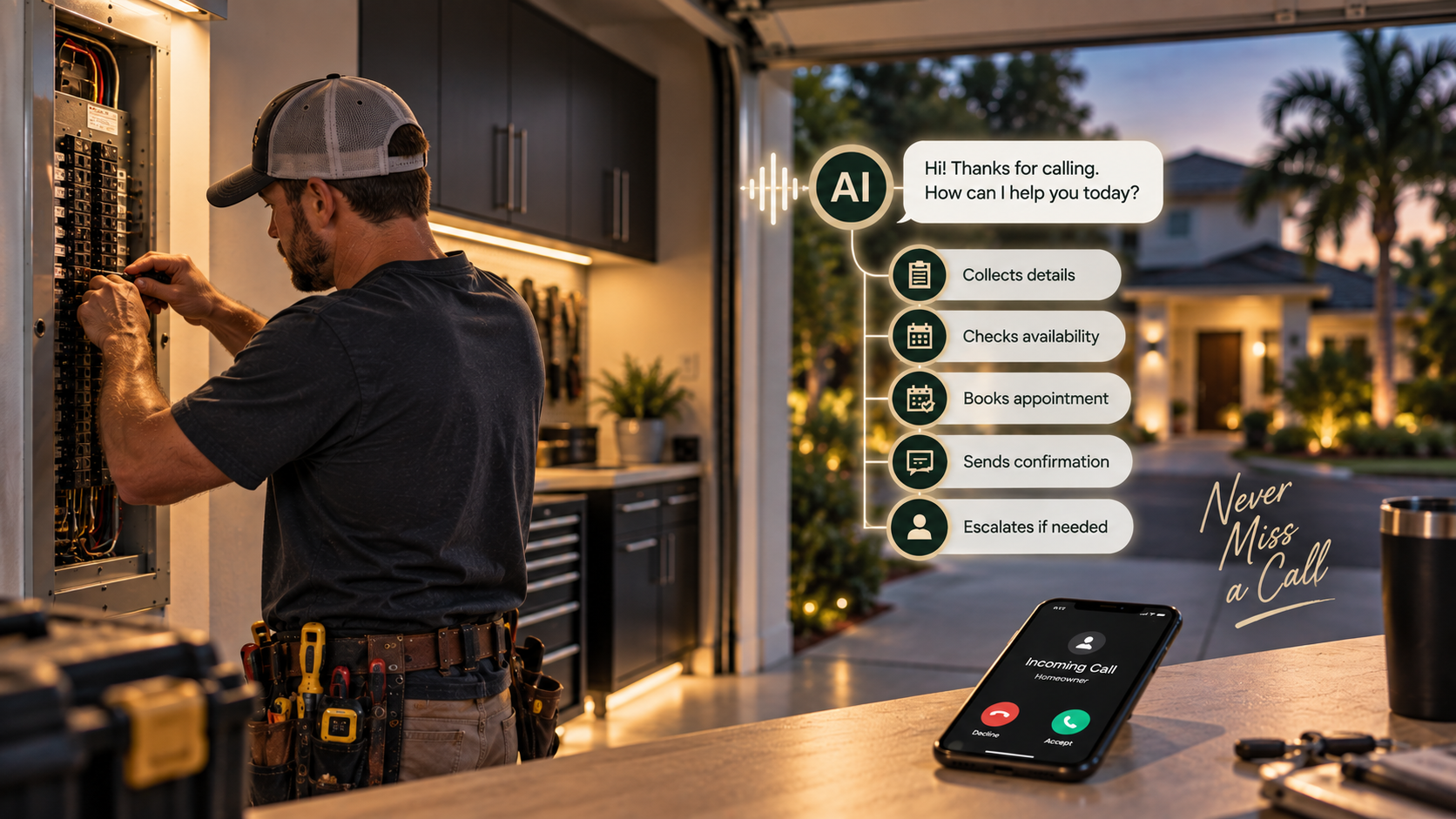
But you can automate or systematize much of what surrounds that skilled work: lead capture, missed-call response, appointment reminders, estimate follow-up, customer communication, review requests, CRM updates, internal handoffs, recurring follow-up and reporting.
The goal isn't replacing skilled people with AI. It's stopping skilled people from spending their limited time doing work that doesn't require their skill.
When skilled labor is scarce, operational efficiency becomes a growth strategy.
5 Moves Contractors Can Make Now
Find where skilled time is being wasted
For one week, track administrative work performed by the owner, electricians, technicians and other high-value employees. Look for scheduling, data entry, customer updates, estimate chasing and repetitive communication that can be reassigned, systematized or automated.
Measure revenue leakage before buying more leads
Review what happens after someone calls, submits a form or requests an estimate. Track: Lead → Contacted → Scheduled → Estimate → Follow-Up → Closed. Find the largest drop-off. Fix that before automatically increasing advertising spend. Run the Revenue Leakage Calculator to estimate what those gaps are costing you.
Automate the repetitive parts of the customer journey
Start with high-frequency, low-judgment processes such as missed-call response, appointment confirmations, reminders, estimate follow-up, review requests and customer reactivation. Automation should support your team, not create a colder customer experience. See how Missed Call Text Back and AI Chat & Reception fit into that flow.
Document the way work gets done
If important processes live entirely inside the owner's head, hiring won't completely solve the capacity problem. Build straightforward SOPs for lead handling, scheduling, estimates, customer communication, purchasing and follow-up. Better systems make future hires more productive. A connected Growth System makes those workflows repeatable instead of dependent on memory.
Build recruiting before you're desperate
The new survey contains another important signal: 49% of contractors said they added or increased online recruiting strategies such as social media and targeted digital advertising during the past year. Your digital presence isn't only selling your business to potential customers anymore. It's also helping sell your company to the people you hope will work there.
What We're Watching
Data-center construction. Continued AI infrastructure investment could increase competition for electricians and other skilled trades even in markets far removed from individual data-center projects.
Wage pressure. Nearly half of surveyed contractors performing data-center work reported increased wage pressure associated with those projects.
Contractor technology adoption. As labor remains constrained, expect contractors to continue exploring AI reception, CRM automation, scheduling tools, estimating support and other systems designed to increase operational capacity.
The companies that gain the most won't necessarily be the ones using the most AI. They'll be the ones using technology where it removes friction from real operations.
Related Visionary Edge Resources
Sources & Further Reading
Where Is Your Business Losing Capacity?
You may not need more leads. You may need a better system for converting and serving the opportunities you already have. The Visionary Edge Growth Audit examines your lead response, follow-up, customer journey, CRM, automation, reviews and retention to uncover where revenue and capacity may be leaking.
Get Your Free Growth Audit