The Edge in 30 Seconds
The Shift
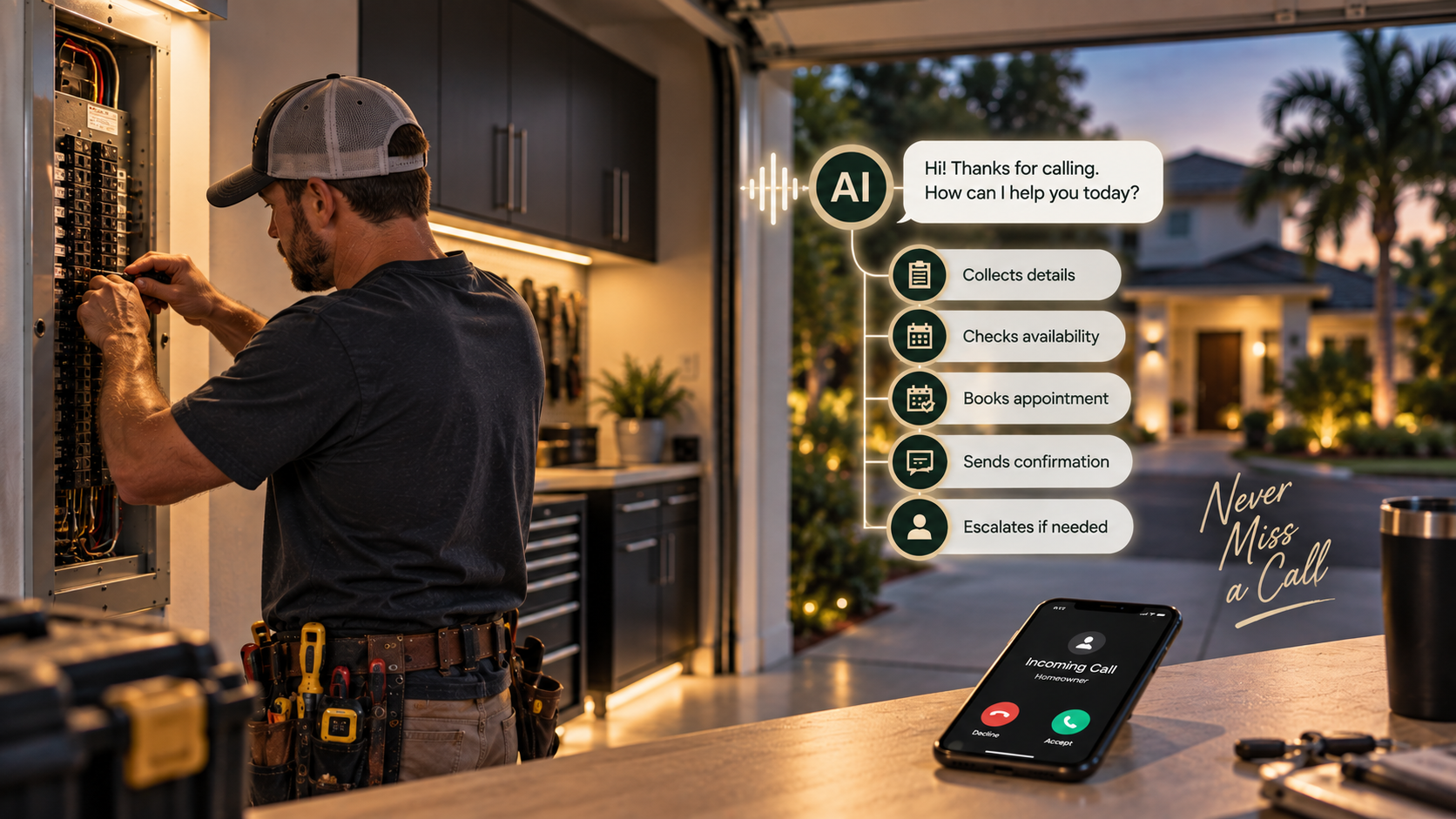
AI voice technology is moving from experimental chatbots into the everyday contractor technology stack, with platforms increasingly able to answer calls, collect job details, check availability, route urgent situations, and schedule appropriate appointments.
The Risk / Opportunity
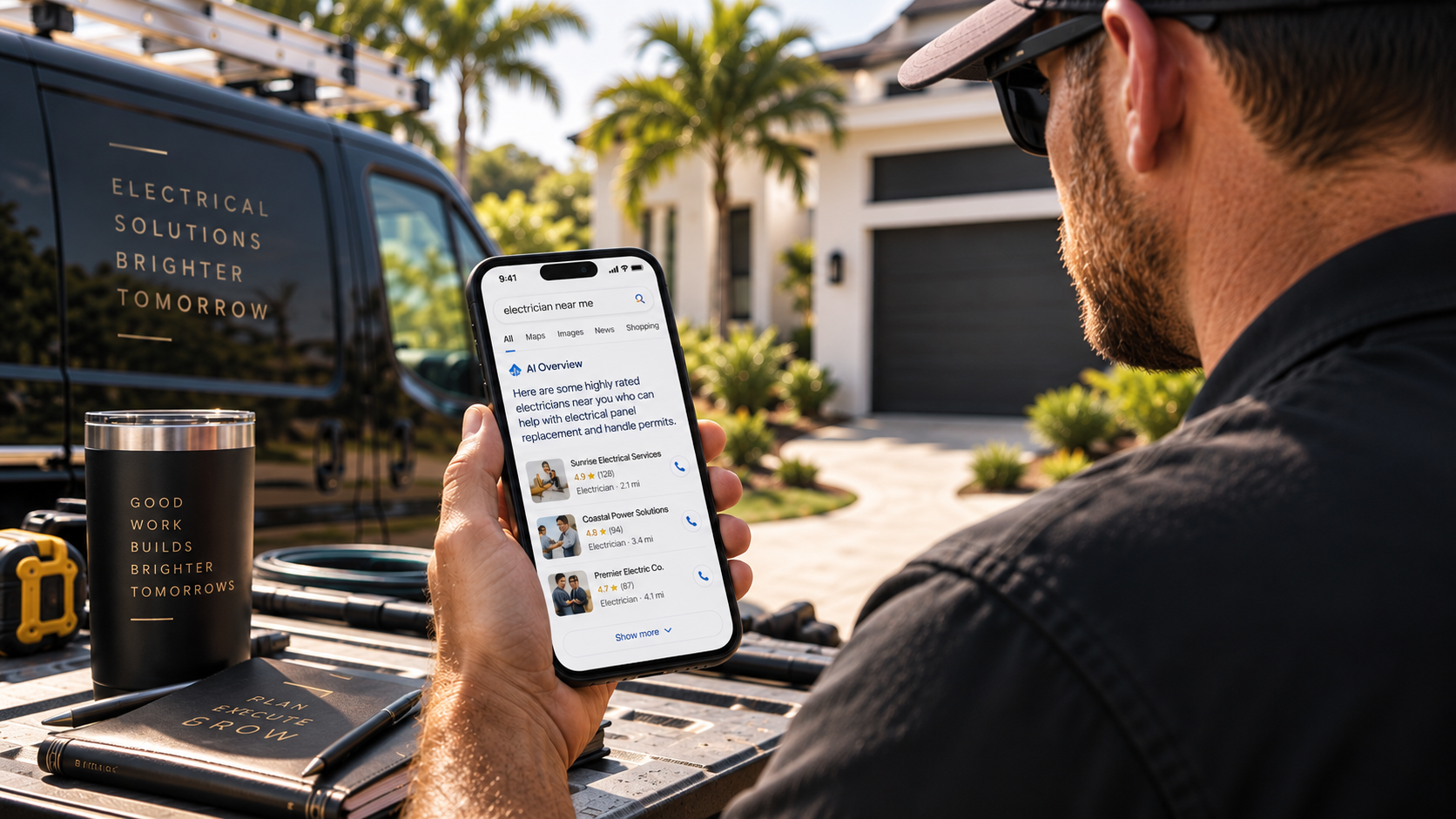
Every unanswered call creates a potential break in the customer journey, especially when the caller has an immediate service need and can contact another contractor within seconds.
The Move
Audit what happens to your calls when nobody answers, then build the right safety net — whether that's missed-call text back, overflow answering, an AI receptionist, or a combination of AI and human escalation.
Contents
The Development
AI voice technology has matured well beyond basic phone trees and scripted IVR systems. Modern conversational AI can understand natural-language requests, hold a multi-turn exchange, and take action on what it learns — in a voice that no longer sounds robotic.
Depending on configuration and integration, today's systems can, to varying degrees:
- answer inbound calls in your business's name
- understand natural-language requests instead of rigid menu prompts
- capture contact and job information
- answer approved FAQs about services, hours, and service areas
- determine service-area eligibility
- check calendars or scheduling systems for availability
- book approved appointment types
- send confirmations by text or email
- log information into a CRM
- escalate calls to a human according to business-defined rules
It is important to be precise: capabilities vary significantly by platform and implementation. Not every AI receptionist can perform all of these functions, and the quality of each depends heavily on how the system is configured, trained, and connected to the rest of your operations. What has clearly changed is the floor — the baseline of what a capable system can do is now substantially higher than it was even a year ago.
Why It Matters
A missed call is not automatically lost revenue. But it is a potential leakage point in the customer journey — and after-hours calls are where that leakage tends to concentrate.
A homeowner calling at 8 PM about a breaker that won't stay reset is not browsing. They have an immediate need, and they are usually calling more than one business. If your line goes to voicemail and a competitor's line reaches a responsive system, the job can be spoken for before your office opens in the morning.
Response speed has long been one of the strongest predictors of who wins a service job. AI reception shifts the economics of that race. The first responder is increasingly a system, not a person — and the business whose system answers first and keeps the conversation moving is the one that earns the booking.
What This Means for Service Businesses
A missed call isn't automatically lost revenue. But it is a potential leakage point in the customer journey. The right way to think about it is as a funnel, not a single moment.
A service business should be able to measure the path from the first ring-3 to closed revenue:
Calls received → calls answered → leads captured → qualified opportunities → appointments booked → appointments completed → estimates → closed revenue
Notice what this makes clear: the goal isn't simply "answer every phone call." The goal is to make sure every legitimate opportunity has a clear next step. A call answered but never logged is still a leak. A lead captured but never followed up is still a leak. An appointment booked but never confirmed is still a leak.
AI reception sits inside that funnel as one tool among several — missed-call text back, CRM automation, human follow-up, and booking confirmation all work together. The opportunity is not the AI in isolation. It is the connected system that makes sure a call never reaches a dead end.
AI Reception Is Becoming Part of the Contractor Tech Stack
This category is no longer limited to standalone AI startups. Contractor and field-service software ecosystems increasingly include AI-powered phone and reception capabilities, while specialist AI-reception companies are building specifically for HVAC, plumbing, electrical, and other home-service businesses.
That matters because it changes the question contractors should be asking. The competitive question is shifting from "Should contractors use AI on the phone?" toward "Which calls should AI handle, what systems should it connect to, and where should a human take over?"
The businesses that get this right will not be the ones that simply "have an AI receptionist." They will be the ones who have mapped their call flow, connected the receptionist to their CRM and calendar, defined clear escalation rules, and measured whether more opportunities are actually moving toward a booked job. The technology is becoming accessible; the differentiation is in the implementation.
A Real-World Scenario
It's 8:17 PM. An electrician is home after a full day in the field. A homeowner calls because part of the house has lost power and the breaker will not stay reset. Two very different customer journeys can unfold from this single call.
Journey A — The dead end
- 1.The phone rings.
- 2.Voicemail answers after several rings.
- 3.The customer leaves no message.
- 4.The customer searches again and calls the next business.
Journey B — The connected system
- 1.The phone rings.
- 2.An AI receptionist identifies the business and greets the caller.
- 3.It collects the customer's name, address, callback information, and a description of the issue.
- 4.It follows the company's approved safety and escalation rules.
- 5.It determines whether the situation should be escalated, scheduled, or followed up by a human.
- 6.It records the lead in the CRM and sends an appropriate confirmation.
This example illustrates the business process — not a promise that AI automatically wins the job. For electrical businesses, the AI should not diagnose dangerous conditions or encourage unsafe troubleshooting. Safety-sensitive situations involving smoke, burning smells, sparking, electrical shock, or fire must follow predefined emergency guidance, not ordinary booking logic.
What AI Should — and Shouldn't — Handle
AI can be excellent for
- Answering consistently, every time, around the clock
- Collecting basic lead information (name, address, callback, issue)
- Identifying the service requested and service-area eligibility
- Confirming service areas and answering approved FAQs
- Scheduling approved appointment types
- Sending confirmations by text or email
- Capturing data into a CRM
- Triggering follow-up workflows
Human escalation should remain available for
- Safety emergencies and immediate hazards
- Unusual technical situations
- Upset or frustrated customers
- Complex or custom pricing questions
- Jobs outside standard parameters
- Situations requiring professional judgment
- Anything the AI cannot confidently interpret
For electrical businesses specifically, safety-sensitive calls involving smoke, burning smells, sparking, electrical shock, fire, or other immediate hazards must follow predefined emergency and safety guidance rather than ordinary appointment-booking logic. This article does not provide DIY electrical troubleshooting instructions.
Where are your leads falling through?
The Visionary Edge Growth Audit looks beyond lead generation to identify gaps in response, follow-up, booking, CRM, reputation, automation, and retention.
Get Your Free Growth AuditThe Visionary Edge Take
AI reception isn't really about replacing receptionists. It's about eliminating dead ends in the customer journey.
Contractors spend real money generating awareness through Google, Local Services Ads, SEO, referrals, social media, and paid advertising. If the resulting phone call reaches a dead end, the marketing system did its job — but the customer journey failed afterward. That is the gap that costs you, and it usually happens long before a competitor outbids you on price.
AI reception, missed-call text back, CRM automation, and human follow-up should therefore be treated as components of one lead-conversion system, not isolated technology features. The call that an AI receptionist captures only becomes revenue if the CRM logs it, the automation follows up, and a human closes the loop when it matters.
The smartest automation doesn't remove the human relationship. It makes sure the human relationship has a chance to begin.
What to Do Next
Measure the gap
Review at least 30 days of call data. Identify total inbound calls, unanswered calls, after-hours calls, repeat callers, voicemails, and leads ultimately recovered. Establish the real leakage point before buying software. If you can't see this, that itself is the first leak to fix.
Fix the simplest failure first, then map the flow
If missed calls currently reach a dead end, implement immediate acknowledgment such as missed-call text back while you evaluate more sophisticated reception options. Then map your call flow before training any AI: services offered, service areas, business hours, appointment types, FAQs, information that must be collected, escalation conditions, safety rules, and exactly when AI must hand the conversation to a person. Do not promise a universal "within 60 seconds" benchmark unless your actual workflow supports it.
Connect reception to the rest of the system — and measure business outcomes
Where supported, connect the receptionist to your CRM, calendar, pipeline, customer notifications, follow-up automation, and reporting so the call never becomes another isolated data silo. Then track business outcomes, not novelty: lead capture rate, booking rate, qualified appointments, human escalations, no-shows, closed jobs, and revenue attributable to recovered opportunities. Don't judge the system merely by how human the AI voice sounds.
Watch This
AI reception is still moving quickly. Watch for deeper integration with contractor field-service platforms, real-time capacity-aware scheduling, improved emergency triage, bilingual and multilingual voice handling, smoother AI-to-human handoff, reliable CRM write-back, outbound estimate follow-up, and better quality assurance and call monitoring.
Disclosure, consent, privacy, and evolving AI regulations are also worth tracking closely — requirements around how callers are informed that they are speaking with an AI are still taking shape.
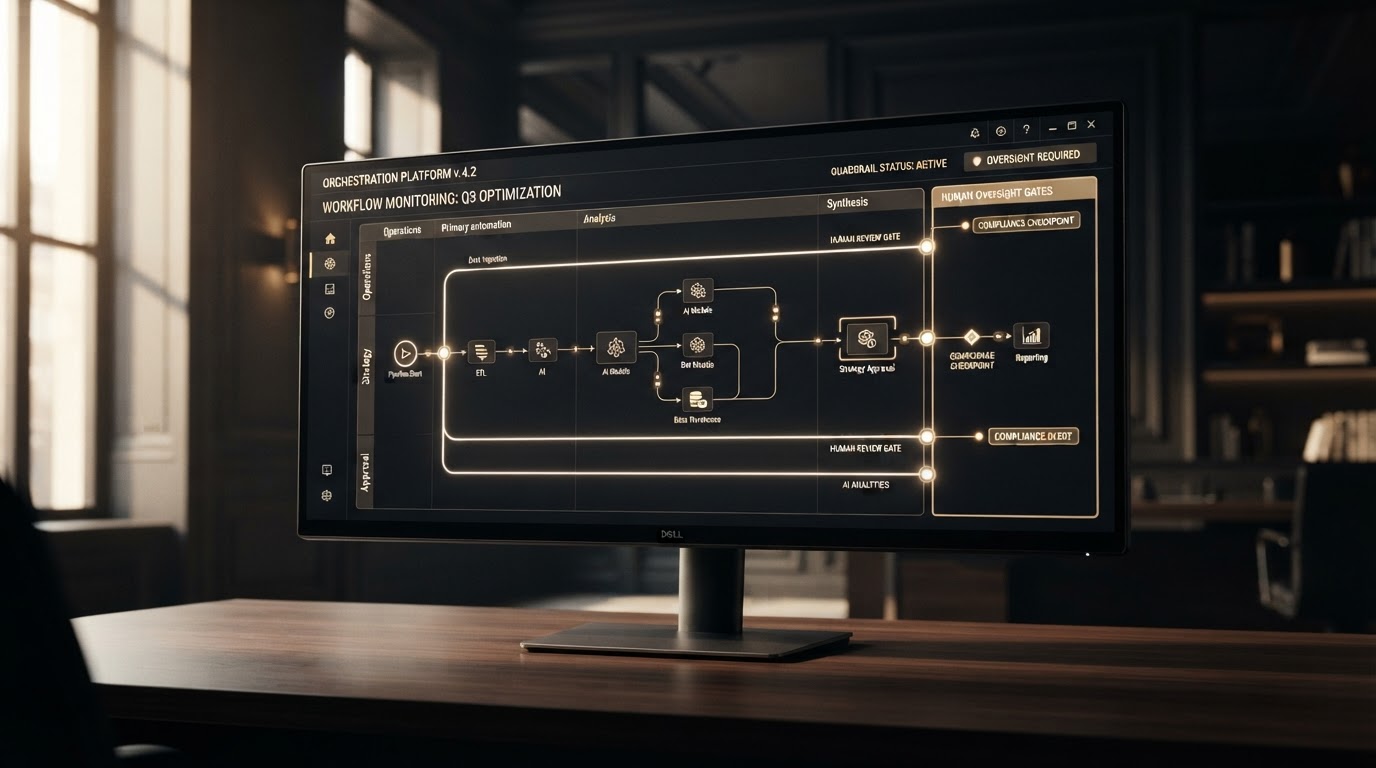
The next competitive advantage will likely come from integration and operational intelligence, not merely having an AI voice answer the phone.
Related Visionary Edge Resources
Sources & Further Reading
More leads aren't always the answer.
Sometimes the opportunity is already calling — and what happens next decides whether it becomes revenue. The Free Growth Audit maps the gaps in your lead response, follow-up, customer journey, automation, reviews, and retention.
Start Your Free Growth Audit