The Edge in 30 Seconds
The Shift
OpenAI's GPT-6 Astra represents another step toward AI that can participate in actual digital workflows. OpenAI describes capabilities including filling online forms, updating CRM customer records, organizing calendars, conducting research and working across professional tools.
The Risk / Opportunity
Across service businesses, valuable people spend part of every day on repetitive digital work that does not require their expertise.
The Move
Start with high-frequency, predictable, low-risk work. Automate that before attempting to automate judgment-heavy customer interactions or professional work.
Contents
From AI Assistant to AI Operator
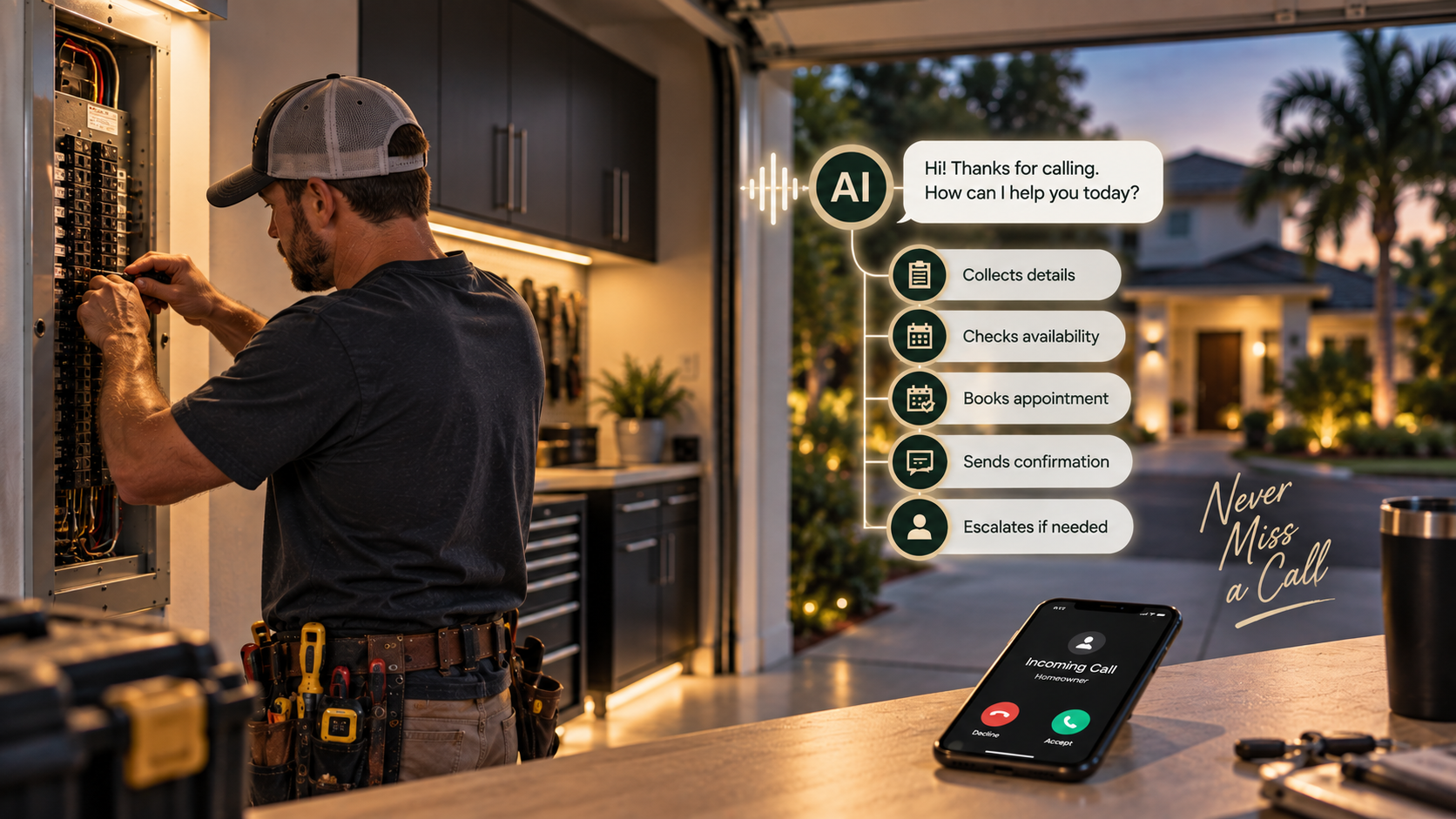
A plumber is underneath a sink when a new lead arrives. A med-spa provider is with a client when the phone rings. An HVAC owner is driving between appointments while two estimates wait for follow-up. A consultant finishes a client call with four CRM updates and three follow-up tasks waiting. An electrician wraps up a panel replacement while tomorrow's appointment reminders still haven't gone out.
Different businesses. Same problem. The people creating the most value are often interrupted by work that doesn't require their expertise.
That's why OpenAI's latest AI release matters to service businesses. On September 3, OpenAI introduced GPT-6 Astra, describing a system capable of increasingly sophisticated end-to-end work across computers, browsers and professional tools. OpenAI specifically describes tasks including updating CRM customer records, filling online forms, organizing calendars, conducting research and creating professional work products.
The bigger story isn't simply "AI got smarter." It's that the boundary between AI advising someone about work and AI participating in the workflow continues to move.
The conceptual distinction matters here. An AI assistant says: "Here's what you should do." An AI operator says: "I can help complete the approved steps." "Assistant to operator" is a Visionary Edge Ventures explanatory framing of this shift — not an official OpenAI product taxonomy unless OpenAI itself uses that terminology in the cited source.
And real-world automation still depends on software, permissions, integrations, workflow design, safeguards, and human oversight. AI capability does not mean every task should be handed over automatically.
From Assistant to Operator
Answer — "Here's the information."
Create — "Here's the finished draft."
Connect — "I can use information from approved business systems."
Act — "I can complete approved workflow steps."
Orchestrate — "I can coordinate multiple approved steps across a workflow."
The important shift isn't smarter chat. It's AI becoming capable of participating in the workflow. — Visionary Edge Ventures framework
Why This Matters to Service Businesses
Many service businesses share the same operational problem even though the actual service is different.
- HVAC: technicians create value diagnosing and repairing systems.
- Med Spa: providers create value serving clients and delivering appropriate professional care.
- Plumbing: skilled professionals create value solving physical problems in homes and businesses.
- Professional Services: experts create value through analysis, advice, strategy and relationships.
- Electrical: electricians create value through skilled, safety-sensitive field work.
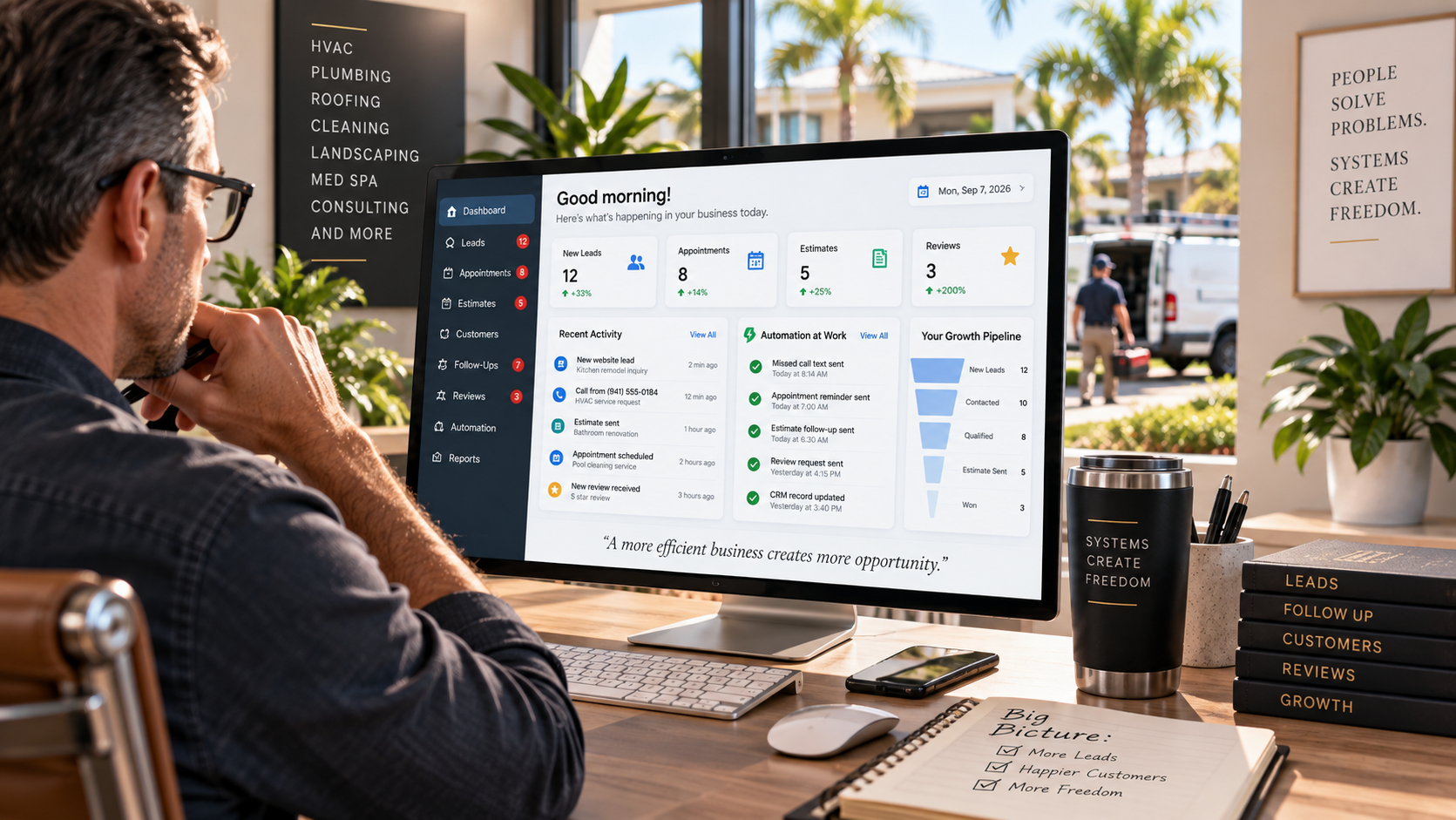
Yet each business also generates repetitive surrounding work: leads, calls, CRM updates, scheduling, reminders, follow-up, reviews, customer communication, and administrative handoffs. That surrounding work is where automation can create capacity.
The Service-Business Automation Hierarchy
The most useful way to decide what to automate is to sort work by how often it repeats and how much human judgment it actually requires. Here is a practical hierarchy.
Automate First
High frequency · Predictable · Low judgment
Lead capture, missed-call acknowledgment, appointment confirmations, routine reminders, review requests, routine CRM administration, basic follow-up triggers.
Automate With Guardrails
High frequency · Moderate judgment
Lead qualification, scheduling and rescheduling, AI reception, estimate and proposal follow-up, customer reactivation, approved FAQ responses.
Human-Led, AI-Assisted
Higher judgment
Complex estimates and proposals, complaint resolution, high-value sales conversations, unusual customer situations, professional analysis.
Keep Human
High consequence · High judgment
Safety decisions, regulated professional judgment, technical diagnosis, consequential financial decisions, unusual pricing commitments, emotionally sensitive situations.
Visionary Edge Ventures decision framework. Different industries may place the same task in different categories. A routine scheduling decision for one business may require meaningful technical, safety or professional judgment in another. Automation design must reflect the actual business.
The Service-Business Automation Matrix
Quadrant I
Automate First
High repetition + low judgment. Examples: missed-call text back, reminders, review requests.
Quadrant II
Automate With Guardrails
High repetition + moderate judgment. Examples: lead qualification, scheduling, AI reception.
Quadrant III
Human-Led, AI-Assisted
Lower repetition + higher judgment. Examples: complex estimates, complaint resolution.
Quadrant IV
Keep Human
High consequence + high judgment. Examples: safety decisions, technical diagnosis.
Automation potential generally rises as repetition increases and required human judgment decreases. — Visionary Edge Ventures decision framework. Not OpenAI research.
The takeaway: start where the work is frequent and the stakes of a mistake are low. Layer in guardrails as judgment increases. And keep the high-consequence, high-judgment calls firmly in human hands.
Five Businesses. Five Automation Opportunities.
Different service. Different expertise. Same opportunity to remove repetitive administrative friction. Here are five concise examples of where each business type can automate first.
HVAC
Missed inquiry → immediate acknowledgment → basic qualification → appropriate scheduling → confirmation.
Med Spa
New inquiry → approved service information → consultation booking → reminder → appropriate human handoff. (AI should not provide clinical judgment.)
Plumbing
Urgent inquiry → information capture → approved triage or escalation path → scheduling or human dispatch decision. (Do not instruct customers through dangerous repairs.)
Professional Services
Inquiry → CRM record → discovery scheduling → preparation workflow → follow-up.
Electrical
Estimate sent → scheduled follow-up → response captured → human brought in for scope, pricing or technical questions.
Five businesses. One principle: different service, different expertise, the same opportunity to remove repetitive administrative friction.
Don't Automate the Relationship Out of the Business
Service businesses sell something technology cannot independently manufacture: trust.
Customers hire professionals because they want some combination of expertise, reassurance, judgment, accountability, communication, empathy, and human connection. Automation should not remove those things. It should remove repetitive friction surrounding them.
Good automation can make sure the inquiry is captured, someone gets a response, information reaches the right place, appointments aren't forgotten, follow-up actually happens, and the human gets involved when judgment matters.
The goal is not a business without humans. The goal is a business where humans spend more time doing the work humans are actually needed to do.
Before you add another tool, find the bottleneck.
The Visionary Edge Growth Audit examines your website, lead capture, CRM, follow-up, automation, reputation and customer journey to identify where time, leads and revenue may be leaking.
Get Your Free Growth AuditThe Visionary Edge Take
The businesses that win the next phase of AI adoption won't necessarily be the businesses with the most automation. They'll be the businesses that understand where automation belongs.
A messy process automated is still a messy process. A broken customer journey with AI layered over it is still a broken customer journey. And automating a process nobody understands can simply make mistakes happen faster.
The sequence matters: understand the customer journey, find the friction, define the process, determine where judgment is required, then automate the repeatable parts.
The best automation doesn't replace the relationship. It clears away the work preventing your people from building one.
— Shannon Martel, Visionary Edge Ventures
Don't measure AI maturity by how many tools you have installed. Measure what actually matters: response time, lead capture, follow-up consistency, appointments, conversion, customer experience, hours returned to the team, and revenue protected.
5 Actions Service Businesses Can Take Now
Audit one week of repetitive digital work
Track what owners, office teams and skilled professionals repeatedly do on phones and computers. You are looking for the work that keeps interrupting the work that actually requires expertise.
Identify the most frequent low-judgment task
Pick the recurring operational burden that repeats most often and carries the lowest risk if a step is handled automatically. That is your first automation candidate — not the most impressive AI capability.
Map the process before automating it
Define the trigger, the steps, the exceptions, the desired outcome, and the human handoff. Automating a process nobody has mapped is how mistakes start happening faster.
Define the judgment threshold
Explicitly determine when automation stops and a human takes over. Write it down. A clear handoff rule protects both the customer experience and the people doing the skilled work.
Measure the business result
Track response time, appointments, follow-up, conversion, customer experience, time saved, and revenue — not how many AI tools you installed. The metric that matters is whether more of the work you already paid for actually becomes revenue.
What We're Watching
Watch GPT-6 Astra rollout and availability, computer-use capabilities, longer-running workflows, CRM integration, cross-software workflows, AI-to-human handoffs, permissions and approvals, privacy and security, industry-specific regulation, small-business adoption, and how general-purpose AI becomes reliable operational infrastructure.
Maintain appropriate uncertainty around capabilities and availability. Demonstrations are not yet guarantees about what every business can deploy today.
Related Visionary Edge Resources
Sources & Further Reading
More automation isn't the goal.
A business that responds faster, follows up consistently, captures opportunities and gives its people more time for valuable work is. Visionary Edge Ventures helps contractors and service-based businesses connect the systems behind growth.
Get Your Free Growth Audit