The Edge in 30 Seconds
The Shift
Newly recovered Google Maps and Geostore data reveals 72 visible ranking signals, 793 data-source providers, and 446 local-search intent types, suggesting Google evaluates far more than a single business listing.
The Risk / Opportunity
Focusing only on your Google Business Profile may leave valuable context on the table. Google appears to connect listings with websites, reviews, entities, geography, and behavioral signals to build a broader understanding of your business.
The Move
Do not chase 72 mystery signals. Build a clear, consistent, trustworthy digital presence everywhere Google encounters your business, so it can confidently understand who you are, what you do, and where you operate.
Contents
What Did the Google Maps Research Find?
For years, local SEO advice has centered heavily on one thing: optimize your Google Business Profile. Choose the right categories. Add photos. Get reviews. Keep your hours accurate. Complete every field.
All of that still matters. But newly published research into Google Maps' underlying architecture suggests that focusing on your Business Profile alone may be missing the much bigger picture.
On September 8, Search Engine Land published an analysis of newly recovered Google Maps and Geostore data. Among the findings were 72 visible Geostore ranking signals, 793 data-source providers, 446 local-search intent types, more than 10,000 searchable Geostore declarations, and extensive systems connecting geographic entities, the web, semantic concepts, user context, and Maps rendering.
The headline-grabbing number is 72. But that is not actually the most important discovery.
The bigger story is this: Google appears to be evaluating much more than your listing. It is building an understanding of your entire business. And as Google Maps becomes increasingly intertwined with AI-driven and conversational search, that distinction could become even more important.
There is an important warning here. This is not a newly leaked list of 72 things you should optimize to rank number one in Google Maps. Researchers recovered the names of signals used within a system referred to as Oyster Rank, but not their current weights. Twenty-five of the 72 identified values are also marked deprecated. Google Maps uses additional systems for query interpretation, semantic matching, geography, candidate generation, reranking, personalization, and display.
So anyone publishing a 72-step Google Maps ranking checklist from this research is oversimplifying what was actually discovered. The real value of the research is the architecture surrounding those signals. And that architecture tells us something much more useful.
The Data Behind the Shift
72 visible ranking signals
Researchers examining recovered Google Maps and Geostore data identified 72 visible ranking signals, 793 data-source providers, and 446 local-search intent types inside portions of Google's geographic infrastructure. Among the signal names identified were Google reviews, listing impressions, listing opens, website clicks, direction requests, web query volume, popularity, and prominence.
However, 25 of the 72 identified values are marked deprecated, and their current weights are unknown. Google Maps uses additional systems for query interpretation, semantic matching, geography, candidate generation, reranking, personalization, and display.
Source: Search Engine Land — Inside Google Maps (September 8, 2026)
Your Google Business Profile Is Not the Whole Business
One of the clearest ideas in the research is the difference between a listing and an entity.
Your Google Business Profile is what you see and edit. Behind that interface, Google can maintain a much broader representation of the actual business. That representation may connect information such as business identity, location, website, business relationships, categories and concepts, reviews, other web documents, Knowledge Graph information, behavioral signals, and geographic information.
Think of your Business Profile as the storefront Google lets you edit. The underlying entity is Google's broader understanding of the business behind that storefront.
That explains why simply filling out every field in a profile is not a complete local SEO strategy. You want the information Google encounters across the web to reinforce the same story.
- Who are you?
- What do you do?
- Where do you operate?
- What problems do you solve?
- What evidence supports those claims?
When those answers are clear and consistent across your website, profile, reviews, citations, content, and other trusted sources, Google has more information with which to understand the business.
Why Your Website Matters to Local SEO
This may be one of the most significant findings for local service businesses. The research indicates that Google Maps and traditional web search are not operating as completely separate universes. Google can connect geographic entities with web documents and evaluate the relationship between a page and the entity it describes.
In plain English: your website can help Google understand your real-world business.
That changes the way local businesses should think about service pages, location pages, About pages, project content, FAQs, and educational articles. They are not simply opportunities to rank for another keyword. Collectively, they help establish context around the business.
For a contractor, that could mean clearly explaining which services you actually provide, which communities you serve, what types of projects you handle, your areas of expertise, how customers work with you, what differentiates your business, and how your services relate to specific customer needs.
A thin website paired with a perfectly optimized Business Profile may therefore be leaving valuable context on the table. Your website and your local presence should support each other.
Reviews May Be Doing More Than Building Trust
Reviews have always been important because prospective customers read them. But the recovered Google data reinforces another reason to pay attention to them.
Google reviews appear within the vocabulary of the recovered ranking system, and Google can also understand concepts and topics associated with businesses. That means reviews are not simply a star count sitting beside your company name. They can provide additional evidence about what customers consistently experience.
Consider the difference between dozens of generic reviews saying "Great company!" and reviews naturally describing experiences such as "Responded quickly when our panel started having problems," "Installed our EV charger and explained the entire process," or "Showed up when scheduled and kept us updated."
Those reviews are valuable to humans because they are specific. They may also provide richer information about the business itself.
This does not mean businesses should script reviews or tell customers what to write. It means the best review strategy is still the simplest one: do excellent work, consistently ask real customers for honest feedback, and make reviewing the business easy.
Local Rankings Are Not Just About Distance
Another interesting finding challenges the idea that Google simply draws a fixed circle around the searcher and ranks nearby businesses within it. According to the research, the geographic area considered by Google can change depending on both the query and the surrounding environment.
That makes intuitive sense. Someone searching for a common service in a dense city may have many nearby choices. Someone searching for a specialized service in a less populated area may need Google to look farther.
Distance still matters enormously in local search. But the model appears more sophisticated than closest business wins.
For service-area businesses, this is another argument against trying to game rankings with a pile of city names. Your better long-term strategy is to establish strong relevance and real local authority throughout the areas you genuinely serve.
Is your business built to be found, trusted, and chosen?
Search is changing. But the fundamental business problem has not. You still need the right people to find you, trust you, and have a clear path to becoming a customer. The Visionary Edge Growth Audit looks beyond a single marketing channel to identify gaps across visibility, lead response, follow-up, automation, and conversion.
Start Your Free Growth AuditAI Makes Business Clarity Even More Important
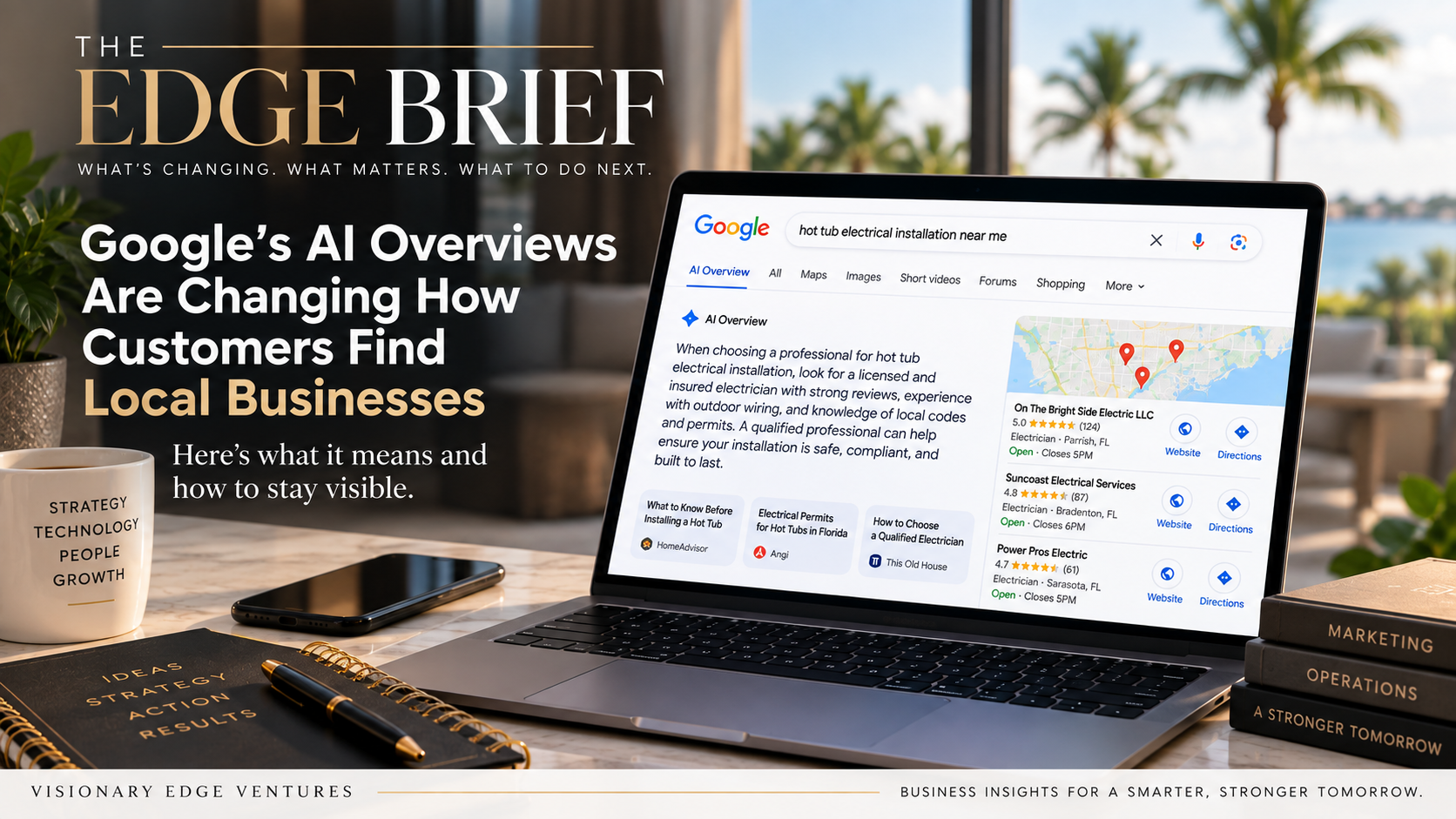
This is where the story becomes especially interesting. Google is increasingly layering conversational AI experiences over Maps and Search.
Instead of asking "Electrician near me," a consumer can increasingly ask something more specific: "Who is a highly rated electrician near me who handles EV chargers and has good feedback about responsiveness?"
To answer that type of question well, Google needs more than a business name and primary category. It needs enough evidence to understand what the company does, where it operates, what specific services it provides, what customers say about it, how trustworthy that evidence appears, and how relevant it is to the person's specific request.
That is why semantic completeness could become increasingly important. Businesses that make themselves easy for search engines and AI systems to understand have an advantage over businesses whose digital presence is fragmented, incomplete, outdated, or contradictory.
Featured Snippet Answer
Is Google Business Profile enough for local SEO?
No. A Google Business Profile remains important, but local SEO also depends on how clearly Google can understand a business across its website, reviews, web references, geographic information, and other entity signals. A complete and consistent digital presence gives search systems more evidence about who the business is, what it offers, and when it is relevant.
The future of local SEO may not simply be about ranking for a keyword. It may increasingly be about becoming a business that Google can confidently understand and recommend.
What Local Service Businesses Should Do Now
Fully optimize your Google Business Profile
Keep your categories, services, hours, contact information, photos, description, and other relevant fields accurate and current. Your profile still matters. It just is not the whole strategy.
Make your website unmistakably clear
A visitor and a search engine should both be able to quickly determine who you are, what you do, who you serve, where you work, and how to contact you. Avoid vague generic copy that could describe any company in America.
Build useful service and location relevance
Create strong pages around your actual services and the areas you genuinely serve. Do not create hundreds of nearly identical location pages simply to stuff city names into Google. Useful beats repetitive.
Build a consistent review system
Do not wait until someone remembers to ask. Make requesting reviews part of your customer workflow. Encourage customers to describe the actual service they received.
Keep your business information consistent
Your company name, phone number, website, service details, and other key information should tell the same story wherever your business appears online.
Create content that proves expertise
Answer the questions real customers ask before they call. Good content helps prospective customers while giving search and AI systems additional context about the problems your company solves.
Think beyond rankings
Visibility means very little if the customer finds you and then encounters a weak website, unanswered calls, slow follow-up, confusing offers, poor reviews, or no obvious next step. The goal is not simply to appear. The goal is to turn visibility into customers through a connected growth system.
The Bottom Line
The biggest takeaway from this Google Maps research is not that marketers discovered 72 secret ranking factors. They did not.
The bigger takeaway is that Google's understanding of a local business appears to extend far beyond the Business Profile itself. Your listing matters. Your website matters. Your reviews matter. Your content matters. Your business information matters. Your local authority matters. And as AI becomes a larger part of how consumers search, the connections between those signals may matter more, not less.
Local SEO is becoming less about optimizing one profile and more about creating a complete, consistent digital representation of the business Google can understand and customers can trust. That is a much bigger job than updating your GBP. But for businesses willing to build it correctly, it is also a much bigger opportunity.
Does Google Maps use 72 ranking factors?
Not exactly. Researchers recovered 72 visible ranking signals associated with a portion of Google's Geostore infrastructure, but those signals are not a complete list of the Google Maps algorithm. Their current weighting is unknown, some are deprecated, and Maps uses additional systems to interpret queries, geography, relevance, personalization, and results.
Is Google Business Profile still important for local SEO?
Yes. Business Profile optimization remains an important part of local SEO. The new research simply reinforces that Google can evaluate information beyond the profile itself, including websites, reviews, web documents, business entities, and geographic context.
What should a small business focus on for local SEO?
Start with an accurate Google Business Profile, a strong website that clearly explains services and service areas, consistent business information, authentic customer reviews, useful content, and a reliable process for turning search visibility into actual inquiries and customers.
Related Visionary Edge Resources
Sources & Further Reading
Find the Gaps in Your Growth System
Getting found is only the first step. If your business is generating traffic but leads are slipping through slow response times, inconsistent follow-up, missed calls, disconnected systems, or an unclear customer journey, more visibility alone will not fix the problem. The Visionary Edge Growth Audit helps identify where your current growth system is working, where opportunities are being lost, and which improvements deserve attention first.
Start Your Free Growth Audit